Introducing Alix Marie, Artpress n.493
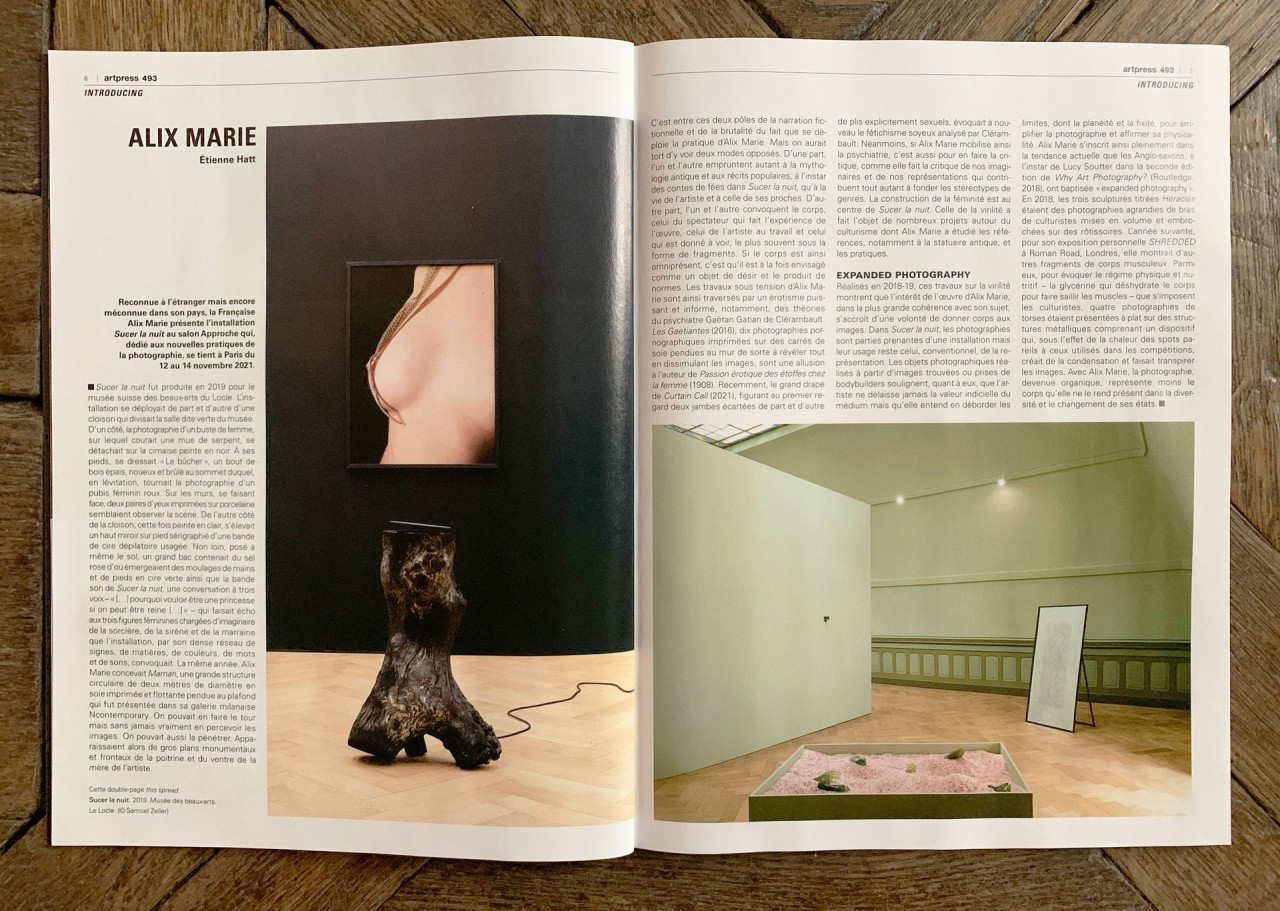
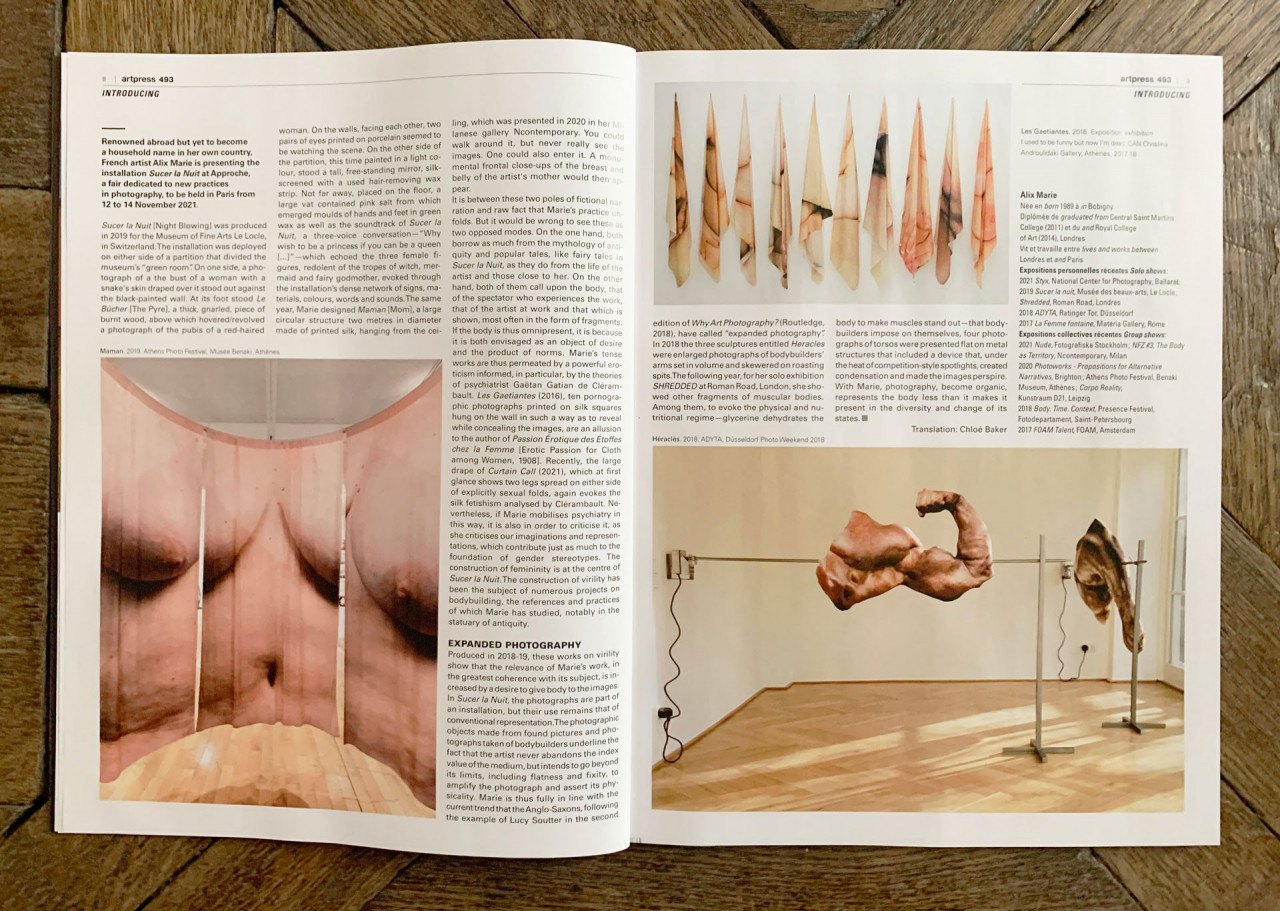
Renowned abroad but yet to become a household name in her own country, French artist Alix Marie is presenting the installation Sucer la Nuit at Approche, a fair dedicated to new practices in photography, to be held in Paris from 12 to 14 November 2021. Sucer la Nuit [Night Blowing] was produced in 2019 for the Museum of Fine Arts Le Locle, in Switzerland. The installation was deployed on either side of a partition that divided the museum’s “green room”. On one side, a photograph of a bust of a woman with a snake’s skin draped over it stood out against the black-painted wall. At its foot stood Le Bûcher [The Pyre], a thick, gnarled, piece of burnt wood, above which hovered a photograph of the pubis of a red-haired woman. On the walls, facing each other, two pairs of eyes printed on porcelain seemed to be watching the scene. On the other side of the partition, this time painted in a light colour, stood a tall, free-standing mirror, silk-screened with a used hair-removing wax strip. Not far away, placed on the floor, a large vat contained pink salt from which emerged moulds of hands and feet in green wax as well as the soundtrack of Sucer la Nuit, a three-voice conversation—“Why wish to be a princess if you can be a queen [...]”—which echoed the three female figures, redolent of the tropes of witch, mermaid and fairy godmother, evoked through the installation’s dense network of signs, materials, colours, words and sounds. The same year, Marie designed Maman [Mom], a large circular structure two metres in diameter made of printed silk, hanging from the ceiling, which was presented in 2020 in the Milanese gallery Ncontemporary. You could walk around it, but never really see the images. One could also enter it. A monumental frontal close-ups of the breast and belly of the artist’s mother would then appear. It is between these two poles of fictional narration and raw fact that Marie’s practice unfolds. But it would be wrong to see these as two opposed modes. On the one hand, both borrow as much from the mythology of antiquity and popular tales, like fairy tales in Sucer la Nuit, as they do from the life of the artist and those close to her. On the other hand, both of them call upon the body, that of the spectator who experiences the work, that of the artist at work and that which is shown, most often in the form of fragments. If the body is thus omnipresent, it is because it is both envisaged as an object of desire and the product of norms. Marie’s tense works are thus permeated by a powerful eroticism informed, in particular, by the theories of psychiatrist Gaëtan Gatian de Clérambault. Les Gaetiantes (2016), ten pornographic photographs printed on silk squares hung on the wall in such a way as to reveal while concealing the images, are an allusion to the author of La Passion Érotique des Étoffes chez la Femme [Erotic Passion for Cloth among Women, 1908].
Recently, the large drape of Curtain Call (2021), which at first glance shows two legs spread on either side of explicitly sexual folds, again evokes the silk fetishism analysed by Clérambault. Nevertheless, if Marie mobilises psychiatry in this way, it is also in order to criticise it, as she criticises our imaginations and representations, which contribute just as much to the foundation of gender stereotypes. The construction of femininity is at the centre of Sucer la Nuit. The construction of virility has been the subject of numerous projects on bodybuilding, the references and practices of which Marie has studied, notably in the statuary of antiquity. Produced in 2018-19, these works on virility show that the relevance of Marie’s work, in the greatest coherence with its subject, is increased by a desire to give body to the images. In Sucer la Nuit, the photographs are part of an installation, but their use remains that of conventional representation. The photographic objects made from found pictures and photographs taken of bodybuilders underline the fact that the artist never abandons the index value of the medium, but intends to go beyond its limits, including flatness and fixity, to amplify the photograph and assert its physicality. Marie is thus fully in line with the current trend that the Anglo-Saxons, following the example of Lucy Soutter in the second edition of Why Art Photography? (Routledge, 2018), have called “expanded photography”. In 2018 the three sculptures entitled Heracles were enlarged photographs of bodybuilders’ arms set in volume and skewered on roasting spits. The following year, for her solo exhibition SHREDDED at Roman Road, London, she showed other fragments of muscular bodies.Among them, to evoke the physical and nutritional regime— glycerine dehydrates the body to make muscles stand out—that bodybuilders impose on themselves, four photographs of torsos were presented flat on metal structures that included a device that, under the heat of competition-style spotlights, created condensation and made the images perspire. With Marie, photography, become organic, represents the body less than it makes it present in the diversity and change of its states.
Etienne Hatt, 2021