Virgo Wound
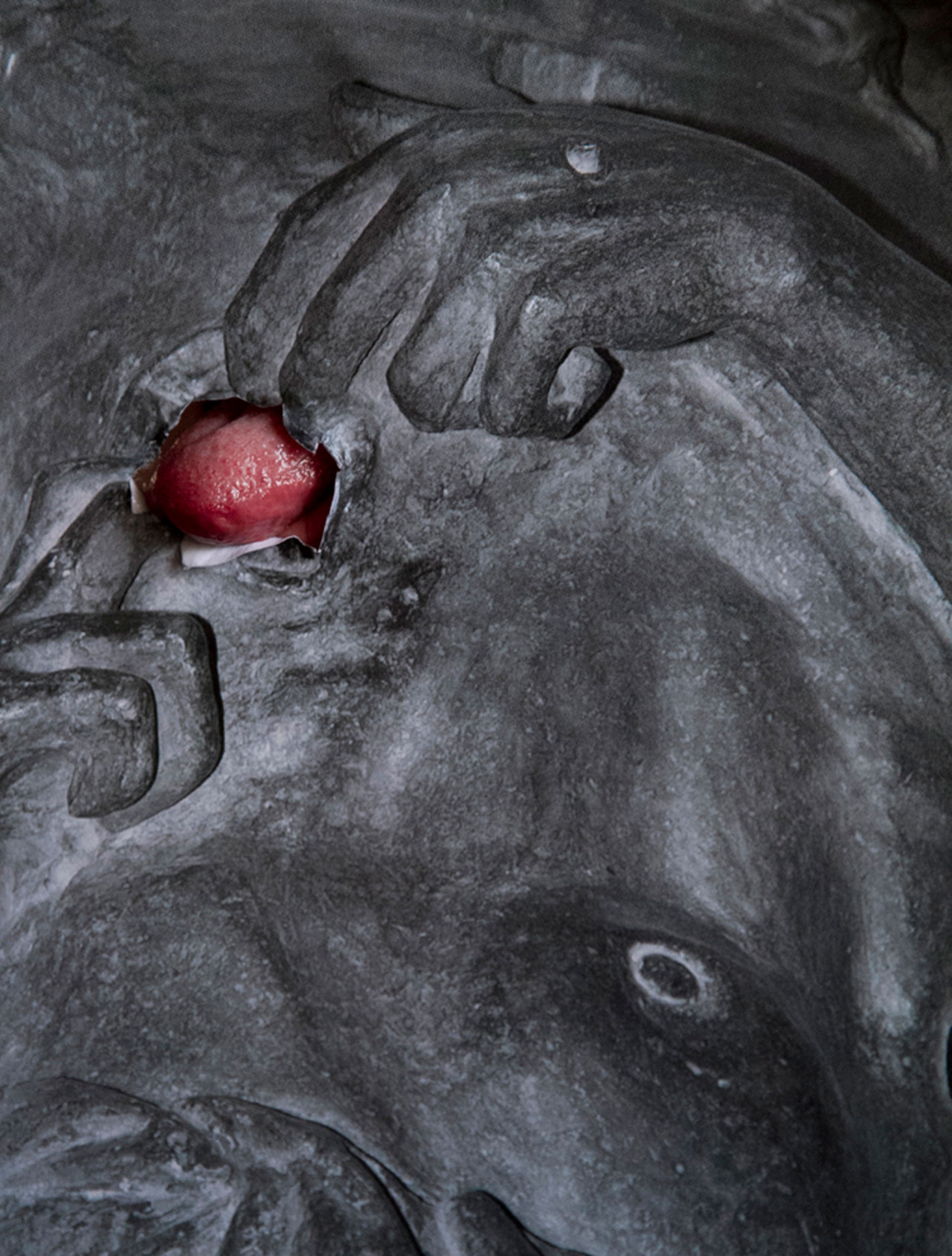
Alix Marie’s work Jesus Wound has traveled with me through various domestic setups and conditions of framing, from bluetack to plastic frame to my current longing to get it mounted and safe behind some expensive glass. It has been hung upside down, fallen off walls, held within busy folders, jumping from state to state with me as I do the same. This skittish nature is also found in the photograph itself. Within the cropped frame, stony fingers pull at the opening of a hole in a grey-sculptured torso, revealing a pink, fleshy tongue. Or is it the tongue that punctures the stone, tearing the slate with a wet, muscular prod? Is this hole a stigma, a vagina, or an anus? The cropping makes it hard to tell; however, the clue may be in the title. Peggy Phelan points out that a stigma is a hole that the eye can never penetrate, but here, a tongue pushes through the wound towards me, the spectator, giving glistening insight into what is normally hidden on theological grounds. Alix Marie’s fleshy prodding in this work makes me think of ‘St Thomas’, aka ‘Doubting Thomas’, in its insistence on reaching through the skin of the body to double-check what is ‘real’. However, this examination produces a hybrid creature, both dead and alive, imaginary and with substance, falling through the camera as an apparatus to grasp with. The mixed use of the camera as a tool for touch while also projecting a screen for fantasy is a hallmark of how I experience Alix Marie’s practice.
Experiencing Alix Marie’s art practice is something I have been engaged in for over ten years as a curator, friend, and, I apologise for blaspheming here, as an astrologer too. These different roles have created a scenario in which I can’t help but make astrological amplifications when Alix and I are discussing her work. The rhymes are just too sweet not to share. So here I am, invoking the spirit of poetry and Mercury, both allergic to literalism, to draw on the ancient repository of images and ideas that is astrology to explore a few dynamics at play in Alix’s practice.
This double move from graspability to immateriality and back again seen in Jesus Wound is played out in Alix’s astrological chart through the heavy emphasis along the Virgo/Pisces axis. Virgo is the sixth sign in the zodiac, ruled by Mercury, and is the mutable sister of the Earth triad. Coming after the sign of Leo, where Solar energy is directed outward, Virgo contracts consciousness and requires us to pay attention to what is specific (the micro) through a process of elimination and purification. It is no surprise that Georges Bataille had this sign as his starry guide, with so much of his work smearing us through the grot of his imagination in the quest for some kind of spiritual cleanliness! He set up the secret society Acéphale in 1936, and the society's symbol was a decapitated Vitruvian man with his intestines articulated instead of the head. Bataille was dislodging the brain as the center of intelligent gravity and reminding us of the cleverness of our digestive system and the workings of the body. Through Virgo, a soul toils at defining subjecthood, mastering order and precision; making a detailed analysis of how bodies exist in the world and their relative use and application.
Yet this pursuit of order is continuously undone by its cosmic counterpart: Pisces. Pisces is the twelfth and final sign on the wheel of the zodiac and speaks to our pre-verbal and pre-conscious experiences in the womb and other life experiences where the sense of separate self/body dissolves into the larger field (the macro). Pisces governs the imagination and states of reverie where logic disintegrates and the image reigns supreme. Think glistening oceans or drowning at
sea… Mental asylums as a location of dissolution and breakdown, as well as the more glamorous ecstatic experience of the mystic (perhaps not so different from the paranoid-schizoid anyway….) Horror and rapture blend through an ambient and ever-grading sparkle.
For anyone who knows Alix Marie’s work, it will be no surprise that the representation of the body is a core issue in her practice. This focus articulates Virgo’s obsession with the correlation between the inner world of mind and feelings, and the outer world of form. However, in Alix’s work, the representation of the body is nearly always confused, swallowed up in some large torrent of the collective imagination, like the slippery performance of gender, or animating myths from the cracks in time, or the archetypal patterns in our family dynamics or… maybe I hear the muted trumpets of Pisces calling.
I loath to reference the abject when writing about an art practice that works with the body, but the breakdown of verbal and bodily sensations in the move from Virgo to Pisces tracks right along the invisible lines of an abject response. In Powers of Horror, Kristeva uses the disorienting experience of encountering the dead body of someone we know to illustrate the potential site of an abject response. A meeting with the abject collapses meaning, taking us somewhere archaic. The dead body or abject phenomenon activates a "primal repression," one that precedes the establishment of the subject's relation to its objects of desire and of representation, before even the establishment of the opposition, conscious/unconscious.
I often encounter a subtle but effective operation of the abject through the relaying between order and disintegration in Alix Marie’s work. Take La Femme Fontaine (2017). On display is a sculptural installation of concrete casts of the artist’s body, water fountains, plastic tubs, and large x-rays of classical sculptures of male gods and demigods. Dismembered concrete body parts (casts of the artist herself) are propped up in strange assemblages, torsos becoming knee becoming foot, limbs jutting at inhumane angles. Other parts look as though they have been discarded as mere detritus. A sense of order through defining a central and coherent body has been corroded, opening up a more Piscean space to encounter the mythical figures of Pygmalion, Galatea, and Niobe invoked in the work, as well as letting Mercury, Virgo's ruling planet, mix the audience up through one of his favourite tricks, the double entendre—La Femme Fontaine punning with the French slang for female ejaculation amongst the pipes and gushing water of the sculptural installation.
Virgo's magic is writ large in the subject matter and material process in Alix’s works Flex (2017), Shredded (2018), and Olympians (2019). Through her sculptural practice, Alix makes fleshy found photos of excessively muscular body parts of bodybuilders, a group of practitioners she feels a kinship with through a mutual dedication to technique and obsession with perfecting form. The gruelling regimes of the bodybuilder are evident in the almost cartoon-like bulges in the works; Virgo's drive to refine the body through purification is front and centre. But the breakdown of order and the Piscean blur is close at hand. Alix states, “At first glance, it appears to be this performance of extreme virility, but actually these men are half-naked on stage wearing golden underwear. So, visually, it is linked to the stereotype of the pin-up or the striptease, which is a feminine cliché.” The usual codes of meaning assigned to extreme expressions of the masculine form break down, and we fall into the open plane of Pisces. Now,
the representation of the body is up for grabs, and more inspired performances of the self are possible.
The opposition of micro and macro as experienced along the Virgo/Pisces axis can be seen working through the logic of fragment and accumulation in the piece Orlando (2014). Here, Alix takes photos of her lover's body through an elaborate process of applying wax, rephotographing, reprinting, and manually manipulating countless shots into sculptural paper objects. She then piles these smaller pieces up into a heap, creating a large and strange installation with a monumental effect. There is a tension between excess and cleanliness, monumentality and the papery insignificance that gives me very real Virgo/Pisces feels and leaves me wondering whether, in Alix Marie’s hands, the body ever truly settles into form or whether it is always, like the Virgo/Pisces emphasis in her chart, in flux: folding between flesh and dream, scrutiny and surrender, surface and soul.
But beyond the Virgo/Pisces axis, another potent configuration pulses through Alix Marie’s chart: Pluto conjunct the Moon in Scorpio in the 8th House. This triad - Pluto, Moon, Scorpio - all resonate with themes of transformation, death, taboo, and psychic depth. Such a chart signature signals a soul called to evolve through confrontation with what lies hidden; whether trauma, power, or truth. In Styx (2021), created during the pandemic, Alix crafts a delicate labyrinth of cyanotype x-rays of intestines. A golden winged hologram tells a looping myth of transformation. The digestive tract becomes both metaphor and material: an underworld map of consumption, decay, and renewal.
Does the penetrating vision of the x-ray reveal the inner workings of the digestive tract/the karmic mastications of the bardo of birth and death or are we lost in the subtle maze of the illusive but slippery promise of understanding? The title of the work, Styx, suggests an irreversible process of Plutonian change, one that, as a collective, we were certainly in the midst of. The question of why some voluntarily get to choose to move across borders (psychic or material) while others are forced to, hangs heavy in the air.
Given the Moon’s placement, the maternal is a vital figure here. The Moon in astrology is associated with our primary caregiver/s and patterns of nurturing and emotional sustenance. With Alix Marie’s Moon conjunct Pluto in Scorpio in House 8, the artist is well aware of the engulfing potential of ‘Mother.’ ‘Mother’- the giver of sustenance and the milk of life, she who can facilitate safety and psychological mirroring, but she who can also take it away in a flash, with one disappointed turn of the head, or worse, a physiological or material breakdown of her own...
This layered and often paradoxical maternal presence finds elegant expression in Maman (2019). The installation invites viewers into an intimate, almost womb-like enclosure formed by soft, suspended drapes. Printed on the fabric’s interior are images of the artist’s mother’s naked breasts - icons of nourishment, exposure, and inheritance. By enclosing the viewer within this soft architecture of flesh and care, Maman stages a visceral confrontation with the primal dynamics of dependence, intimacy, and vulnerability. The work honours the maternal as both
sanctuary and site of psychic entanglement, echoing the Moon-Pluto signature that pulses through Alix Marie’s chart and practice.
And here we see the symbol of the mother alive and present in Alix Marie’s latest body of work - Ana / Ada (2025) which will be exhibited across two venues in the respective cities of Ankara and Izmir in Turkey. Responding to the historical and material context of the shows, the artist engages with the symbology of Anatolian Kilims - flat-woven textiles known for their intricate iconography. Women's stories, so often woven into these textiles, emerge anew, reframed and recharged in Alix Marie’s ceramics and photographic installations.
A consistent praxis of context-specific material and historical research runs through the artist’s work; where historical content becomes material to be shaped, and local materials are folded back into the currents of history. Echoes of bygone images often ripple through the strata of time, surfacing as myths and figures from another age. Alix Marie has Saturn conjunct Neptune in her house of career and public contribution. Saturn represents time, tradition, and history. Neptune rules the realm of images, fantasy, and the subtle complexes involved with our yearning for utopia. With these archetypes blending and forging a working collaboration, I predict that fans of Alix Marie’s work can expect more cultural contributions from the artist that tap us into hidden and mysterious historical imagery - imagery that compels us to dream better and with amplified imagination, for ourselves and each other, with more skill and mastery, if you please!
A final note to end this brief sojourn into Alix Marie’s work via her astrological chart is one of appreciation and respect for the inherent elegance in the artist's creative output, especially evident in Ana / Ada (2025). Alix Marie has Venus, the planet of beauty and aesthetics, in the sign it rules, Libra and in harmonious aspect to her North Node. The karmic imperative in this chart is to contend with the weighter dynamics of the chart through the subtleties of balance, harmony, and beauty, and luckily, we all get to enjoy the fruits of that labour!
Florence Deveureux, 2025