Since we work on the human body
« Their skins were the perimeters of their world. » Harry Crews, Body.
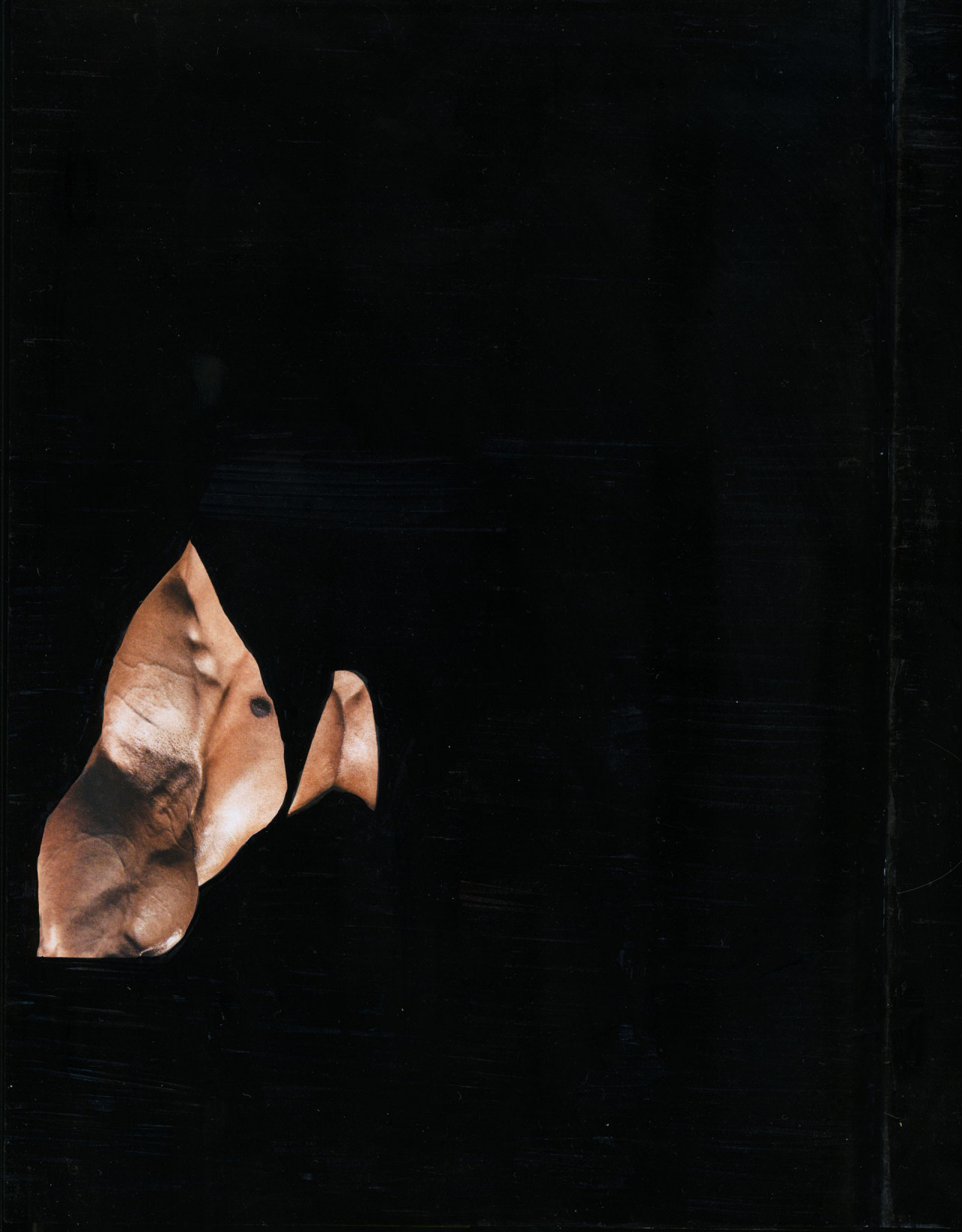
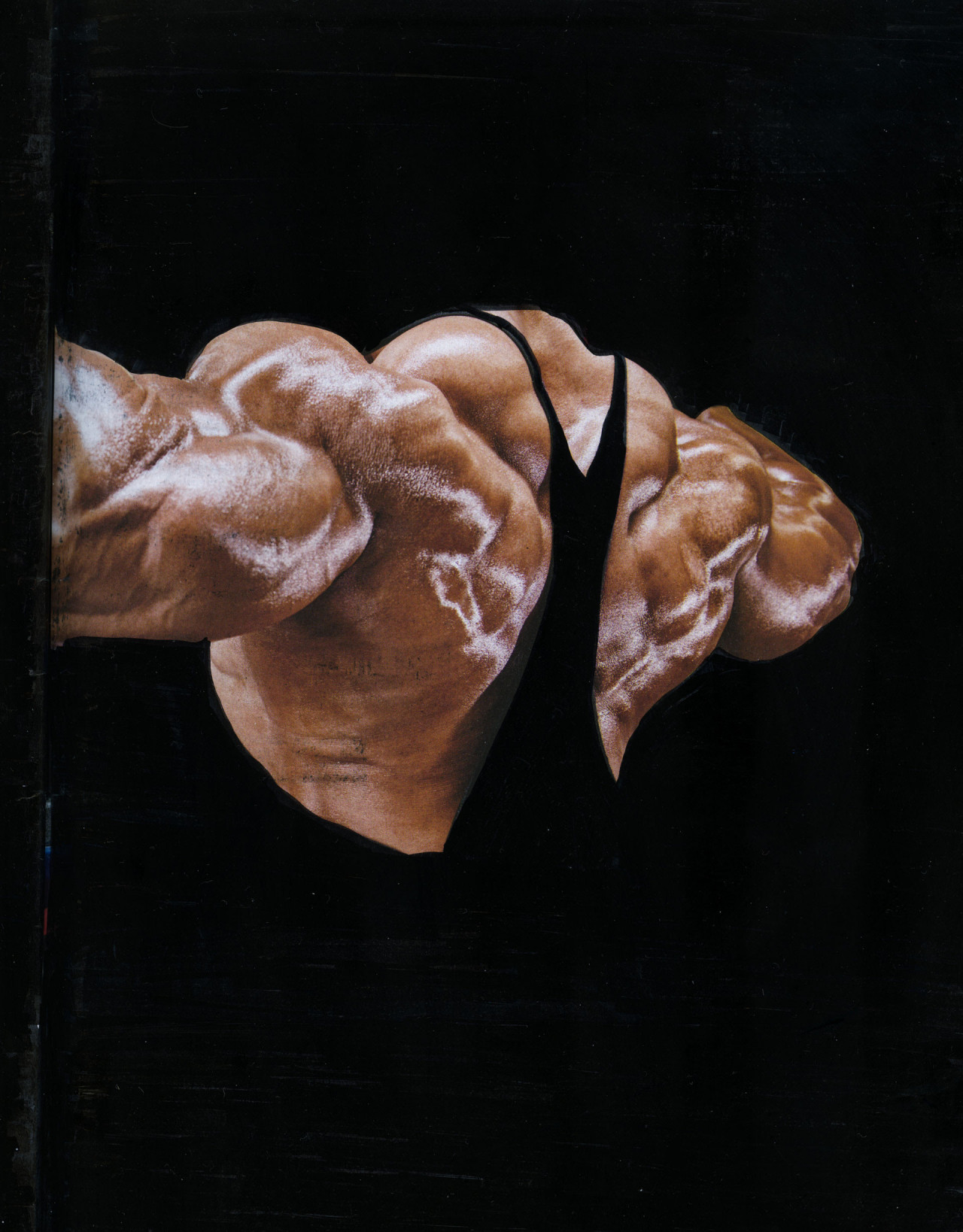
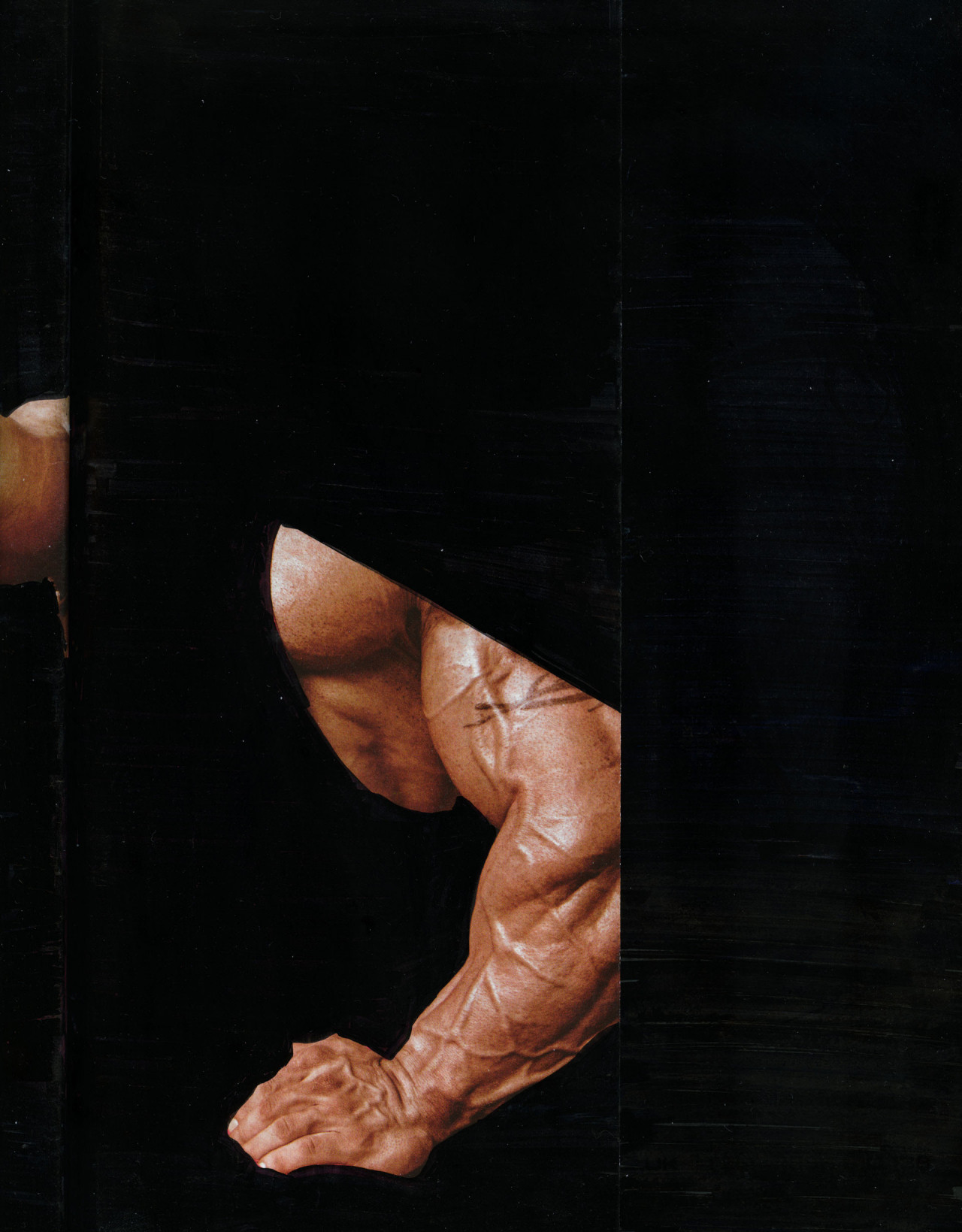
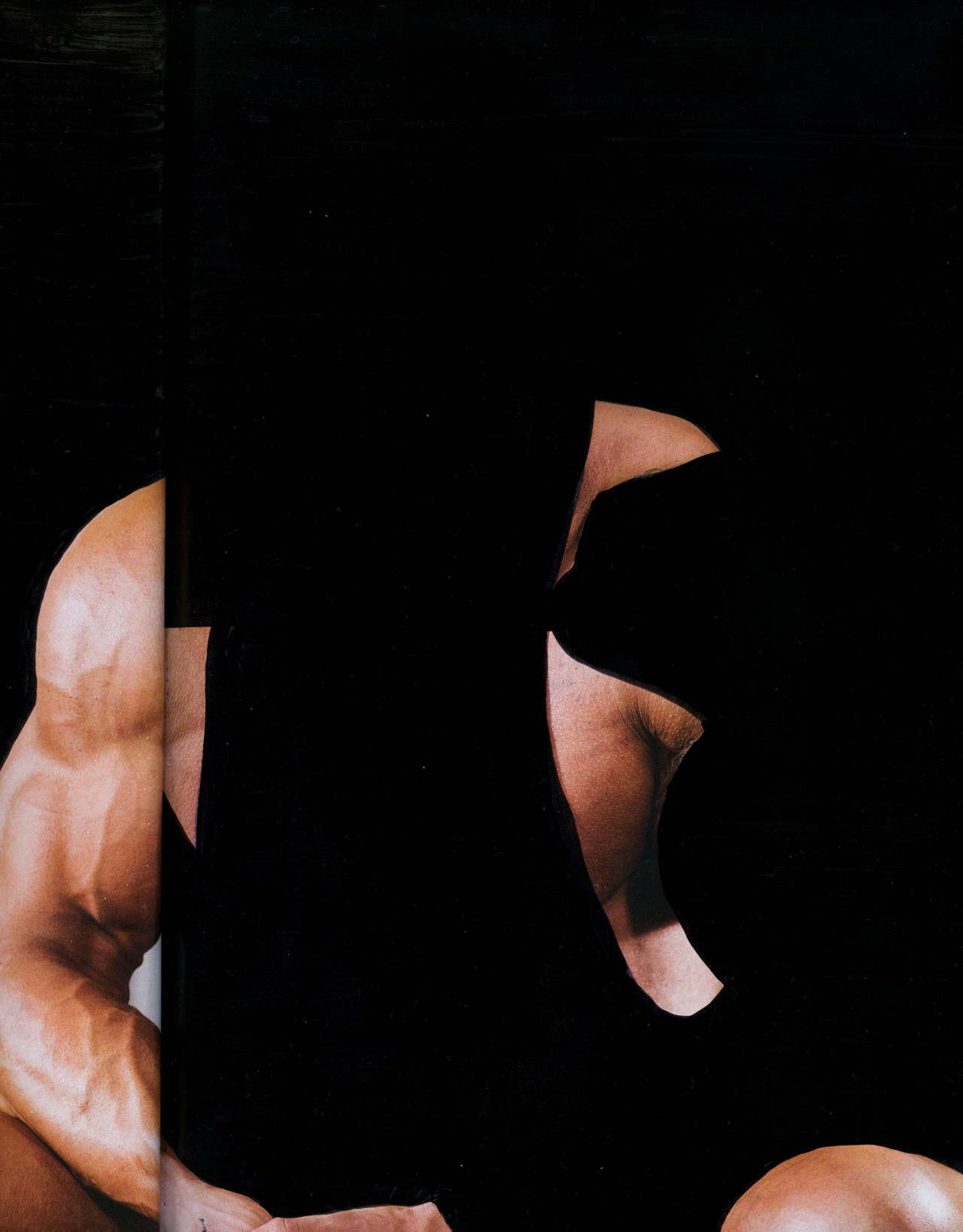
On black pages, shreds bring on a strange reverie. They are peels of men, but with the plasticity of clouds.
Fallen there like autumn leaves, they’re to the eye something more than a catalogue of muscles, scissors-brought from bodybuilding magazines and sewn together by the comments of the sportscaster. They are archipelagos of skin on a sea of ink; planets with veiny relief in a far away galaxy; the stall of a cannibal butcher, the basement where a serial killer organises his morbid trophies (the one of H.H Holmes who, at the same time that bodybuilding, x-radiation and cinema were being invented made a business of selling parts of his victims to medical schools ?); a rock collection similar to the one of Roger Caillois, but arrived from a future of petrified humanity by an unknown Gorgon; the assembly chains of a toy factory, where heroic figurines pieced together will soon be torn by children on their carpets; the scraps where Hollywood, perhaps, piles up the leftovers of all the bodies it has used. Or better yet; the changing room of a bodybuilder, where in between two competitions his rags lie; the night where his exhausted dreams make his olympians program float away - biceps, triceps, quadriceps.
Because she works “on the body” and that she is not alone in this task, Alix Marie knows that it should be found at the precise spot where the obvious and surprise meet - where the body is at the same time itself and something else entirely. And it is strong of this knowledge that she climbed the ordinary Olympus of bodybuilding competitions, strong in the conviction that if bodybuilding is a gift for fine arts, it is on the condition of not feigning to discover behind its back, what itself, in the vulgar innocence of its spectacle, has revealed a long time ago. Thirty years ago, an austrian bodybuilder posed, imitating Rodin’s bronzes, in front of an assembly of art historian gathered for the occasion at the Whitney Museum in New York. The exhibition was called « The Articulate Muscle - The Male Body In Art ». It was claiming that bodybuilding belonged rightly to the history of art, with which it only traded its paint brushes and chisels for weights and a mirror. In retrospect, should we admire the marketing stunt (which was going to favour the colonisation of our imaginary with fitness)? Applaud the pun of this hyphen between culture and culturisme (french word for bodybuilding)? Or take seriously the Austrian, Arnold Schwarzenegger, confirming on the microphone that there is only one gesture from Da Vinci or Michelangelo’s tools to his own - “but it is harder for us - he adds - because we work directly on the human body”?
Olympians invites us to choose seriousness, intensifying the confusion those over-inflated shiny figures expose us to. The series follows its title with a simple and fruitful procedure: erase the faces, which the aesthetic of bodybuilding mourns anyhow; recognise the cadavers behind the advertising of health; at last lay flat the volumes to reduce them to its bare skin, bring back the whole body to the surface, as Alix Marie had already done with her striking installation Hanged, hung, numb, in 2016.
To erase the faces (and the feet, and almost the hands), it is getting rid the bodybuilded of what resists transformation - relieve him of this leftover where the body can only manage to be a body. On stage, the face is only as virtuous as a fanion, there to distinguish a body from the next and save the spectator from drowning in a sea of flesh. Without him, it is the corpse that is exhibited, coming back from anatomy manuals, where the bodybuilder descends from more than athletes. Schwarzenegger is right to see himself as Da Vinci’s heritage: the iconography of bodybuilding sends us back directly to the écorché, the flayed body of Renaissance. The bodybuilder pursues the same goal than Jan van Calcar’s engravings for André Vésale’s Fabrique: to resurface anatomy, show death disguised as life spectacle. Ecorchés, bodybuilders: alive remains.
So goes the skin of bodybuilders, having becoming the sign of what it hides - this “organs filled darkness” mentioned by Merleau-Ponty after Valéry. Their muscles are their skin: envelop, costume, stretched around an imaginary volume. Again Schwarzenegger said it better than no one else playing for cinema the character of a robot whose muscles are just for show, since its strength comes from his metallic entrails. The wonder a bodybuilder arouses, the fascination mixed with dismay, its intensity is the one Olympians perfectly deploys stemming from skin being given as both surface and imprint of depth. A black page after another, it is this depth, it is the night of our bodies, which makes the skin of the olympians shine.
Jérôme Momcilovic, 2019
Translation: David Pickering