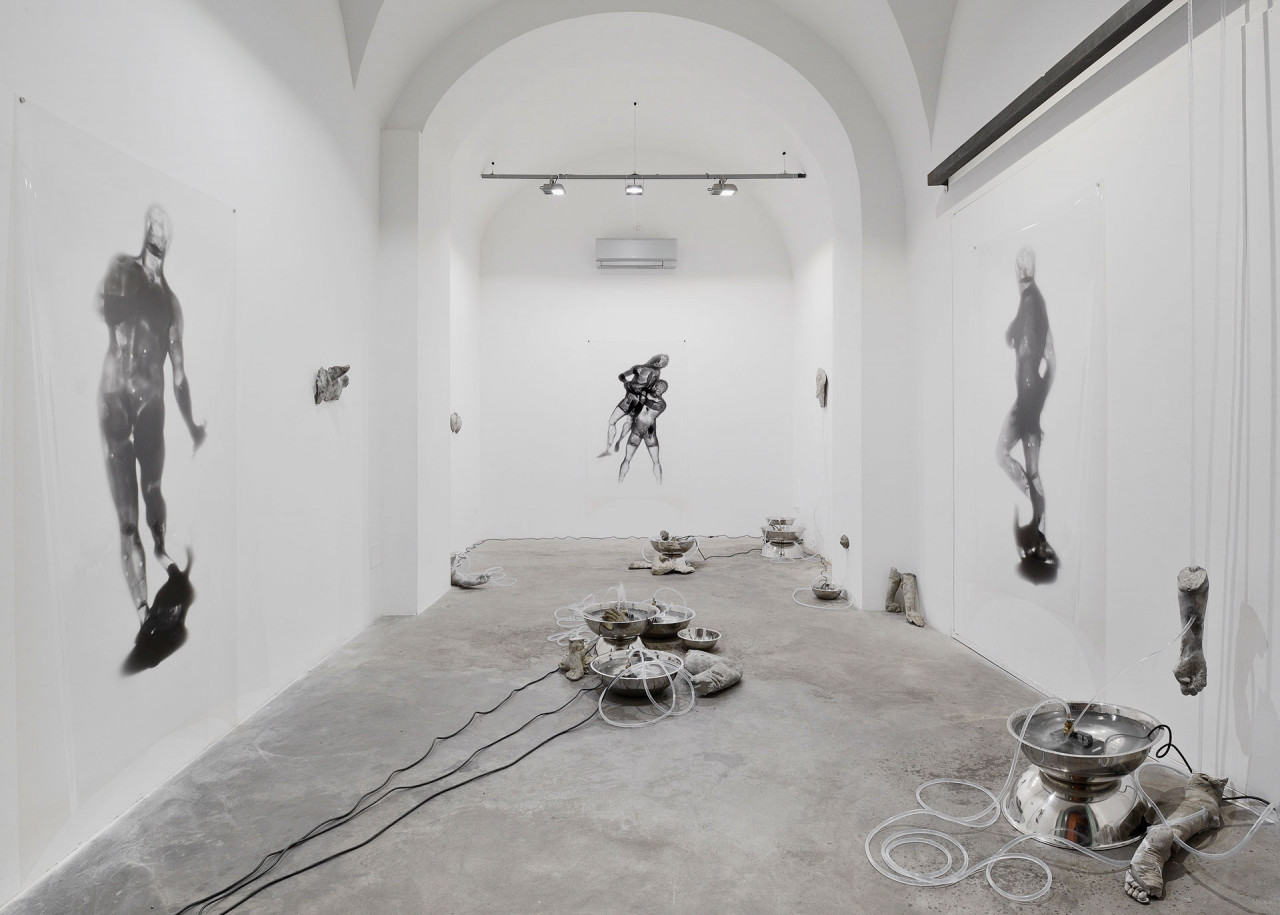
La Femme Fontaine
Alix Marie has created a sculptural installation combining running water, plastic tubes and concrete casts of the artist’s body alongside large X-rays of classical sculptures. A preoccupation with graeco-roman culture is evident not only in this recent work, which responds directly to the context of Rome’s Matèria Gallery (not least in the use of concrete, a material closely associated with the technical advances of the Roman Republic), but throughout Marie’s practise. Artist Tai Shani has compared the fleshy boulders of Marie’s earlier photo-sculptural installation, Orlando (2014), to both elements of the Sisyphus myth and to the emotional dynamics of Eros and Psyche. (2)
For Matèria, Marie’s aesthetic mood is entirely darker.
No tender pink, softly creased surfaces, redolent of both lover’s skin and crumpled bed; no feverish erotic obsession made monumental. The body examined here is not that of a lover, but of Marie herself. This body is heavy, fragmented, sombre. It is cast somewhat misshapenly in grey concrete, threaded through with clear tubing, and placed in clinical metal bowls. Water flows out from its exposed pipes. In conversation, the artist meshes myth and reality: the recent heartbreak of a lost lover, an identification with the mythical Greek figure of Niobe, a childhood fascination with the story of Pygmalion and Galatea.
Niobe, so the story goes, was punished by the gods for a perceived misdeed by the slaughter of all fourteen of her children. Niobe fled the slaughter, but as punishment was transformed into rock. So deep was her grief that tears continued to flow from her stone eyes. The ancient multi-part sculptural tableaux fountain depicting the Niobides in Rome’s Villa Medici is a clear influence on this work in its confluence of myth, rock and water. In this contemporary iteration, water pours from pipes inserted into concrete mouths and flesh-folds.
Concrete is an altogether less allusive material than the illustrious marble of the Niobides fountain, a material more brutal than romantic in its associations— or is it? Limestone, which is concrete’s main ingredient, comes from the dried-out corals, shells and algae of prehistoric seas; when water is added to baked limestone to form concrete, this powdered ocean bed revivifies. (3) Here additionally the rehydrated matter spurts water, and fluids have long been associated with the feminine symbolic. (4) The title La Femme Fontaine puns on the French slang for female ejaculation, that still-disputed phenomena of sexual expression which continues to be the victim of legal and cultural censorship. (5) The use of running water is thus particularly poignant both as a reference to historically either female or feminised emotional outpourings, and to the freedom of sexual expression.
Concrete, in Marie’s native tongue, is béton, from the Old French betum: a mass of rubbish in the ground. The slang phrase ‘laisse béton’ (an inversion of ‘laisse tomber’) means to leave behind something or someone, and these sculptures are, coincidentally, not dissimilar to the historical death-cast. (6) There is something of the abject body and the self as trash in this Bellmerian assembly of discarded parts, remembering that the term abjection literally means the state of being cast off.
Casts have historically been connected to classical portraiture (Pliny the Elder mentions a portrait- casting); casting flourished again with the rebirth of graeco-roman culture in the 15th century. In the 19th century, casting was well-known to both art and science, but was also a more private craft linked to the cult of the personal memento. (7) By the end of the century, life casts even rivalled photography for popularity in the sphere of portraiture. (8) Life casts for private use were usually left plain and unpainted, like La Femme Fontaine. (9) Referring to artistic and scientific material histories, Marie also invokes the laboratory culture of photography through the quasi-scientific aesthetic of tubing and metal bowls.
Like the photograph, the cast is indexical: a temporal and causal imprint. Science’s aspiration to objective truth is referenced through Marie’s investigatory objects, but documentary authority is firmly undercut by the artist’s distortions. Alginate can precisely render detail, but here, in conjunction with concrete, slips, errors and calculated interventions leave areas subtly distorted. The disjunct between indexical casts and sculptural deformations speaks to the slippage between fact and fantasy, rational and emotional truths. The apparent objectivity of the casting technique is both instrumentalised and subverted as the artist forms and reforms herself. As a child, Marie encountered the myth of the sculptor Pygmalion, who fell in love with his sculpture, Galatea; the object of desire became a living, breathing subject. Through taking herself rather than a lover as her starting point (previously a recurring element of her practise), Marie makes manifest her desire to become both sculpture and sculptor, object and subject.
In 1895, Wilhelm Röntgen announced his discovery of the X-ray with an image of his wife Anna’s hand. Produced by passing radiation through her flesh, it reveals her elongated bones veiled in ghostly flesh; in this X-ray only Anna’s large wedding ring appears solid. Röntgen photographed this symbol-adorned hand many times. The first X-ray produced in public also featured a wedding ring. (10) Through this emergent technique, inner substance was brought to the surface and physical inwardness radically penetrated. The iconographic trope of the X-ray with wedding ring can be read as an attempt to temper this clinical perception with a romantic anatomisation; an irrational, unconscious rendering of emotional reality as bone-deep. This history is not unconnected to Marie’s emotional desire to investigate and understand both herself (through her sculptures) and the masculine other (through her work). However, Marie’s X-ray prints are something of an impossible reversal. To try and anatomise the object’s subjectivity by seeing through the body is a hopeless fantasy. In making these images the artist parallels Roland Barthes:
‘To scrutinise means to search: I am searching the other’s body, as if I wanted to see what was inside it, as if the mechanical cause of my desire were in the adverse body (I am like the children who take a clock apart in order to find out what time is). [...] It is obvious I am in the process of fetishising a corpse.’ (11)
The X-rays depict Renaissance sculptures in the classical mode. Marie appropriated these images from the scientific archives of London’s V&A Museum, then digitally inverted their colouration to turn white into black. The radiation penetrated the heavy bronze sculptures to reveal hitherto unseen areas of damage, empty spaces left from the casting process and irregular seams joining limbs. Their monumentality is made fragile and ghost-like. That they are figures of male gods and demigods (Jupiter, Hercules, Anteus) is no irrelevance; in ‘seeing through’ the flesh there is analogous effort to ‘see through’ the impenetrability of hegemonic masculinity. In previous work, Marie has attempted to, in her words, ‘get through the photograph’. Here, we see an attempt to get through the substance itself depicted in the photograph. Emotions are unstable, unreliable; bodies and physical matter reveal themselves to be likewise.
Isabella Smith, 2017
Ben Burbridge, Introduction, in Revelations: Experiments in Photography, ed. Ben Burbridge (London: MACK in association with Media Space and the National Media Museum, 2015), p. 81
Royal College of Art, Alix Marie [n.d.] https://www.rca.ac.uk/students/alix-marie/ [accessed 22 November 2016]
Sadie Plant, Between Shit and Architecture, Keen On Mag, October 2016, http://concrete.keenonmag.com/sadieplant/ [accessed 22 November 2016]
This has been widely explored; see, for instance, Klaus Thewelweit, Male Fantasies,Volume 1: Women, Floods, Bodies, History (Minneapolis: Minnesota UP, 1987)
In 2014, an amendment to the 2003 Communications Act made the depiction of female ejaculation illegal in any pornography produced in the UK.
Adrian Forty, Concrete and Culture: A Material History (London: Reaction Books, 2012), p. 10
This found other manifestations, for example through jewellery made from the hair of deceased loved ones.
Edouard Papet, Historical Life Casting in Penelope Curtis, ed., Second Skin: Historical Life Casting and Contemporary Sculpture (Leeds: Henry Moore Institute, 2002), p. 6
E. Papet, Historical Life Casting, Second Skin, p. 6-7
Ian Jeffrey, Research aesthetics: science and photography, in Revelations: Experiments in Photography, ed. Ben Burbridge (London: MACK in association with Media Space and the National Media Museum, 2015), p.68
Roland Barthes, A Lover’s Discourse, trans. Richard Howard (New York: Hill and Wang), p.71