FOAM Talent Issue 48
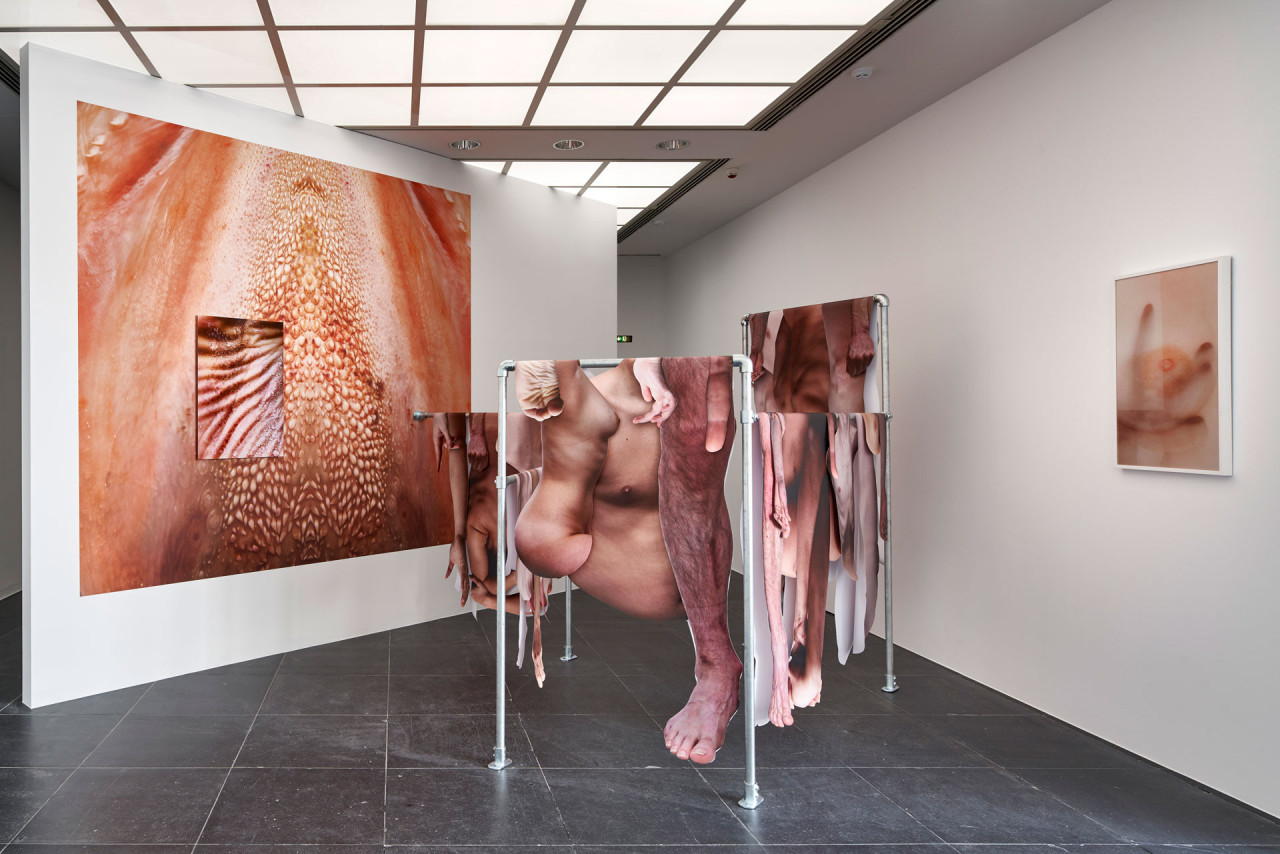
The word ‘grotesque’ shares its origin with grotto, meaning a hidden, underground space, the use of which was often implicitly occult, other-worldly. There’s something ironic, then, about the shift grotesque undergoes in being applied, as it most often is, to the appearance of things – that is, to their surface. Particularly, we think of the grotesque in terms of some putative deviation from a standard, from a norm, which is pushed in these instances toward what is regarded as ugliness or deformity, especially when applied to the human body. But what constitutes a grotesque or ‘normal’ body depends almost entirely on the expectations we bring to it and, in that respect, the perception of an ‘ideal’ body – or indeed of any body – is as much cultural as it is material. Alix Marie’s work is precisely about these interfaces between the cultural and material spaces that the body occupies, somewhere between the gaze and the skin itself.
Of course, this notion of ‘the gaze’ has been a commonplace of critical theory for many years, but it is an appropriate term here in several respects. If it is true that the strangeness of Marie’s subject matter, its grotesquery, is a product of how it is seen, often so different from ‘normal’ seeing, this is at the same time a reminder that seeing as such is always conditional. It essentially creates the conditions by which ‘the subject’ becomes visible – and so, understood. This is the real significance of the gaze. For all that though, the strangeness of the body, of embodiment, as Marie sees it, is not strictly in the image; only our reading of the body resides there, the ways in which we apportion attraction or revulsion (or some characteristically human mix of the two). This strangeness can be parsed in other ways as well. The skin forms a boundary between ourselves and the outside world, marking the limits of the interior, but the line it draws is never quite definitive, being subject to the continual crossing of those boundaries between inner and outer by the traffic of sensation, of touch, pleasure, and pain. So, we have perhaps returned to the idea of the grotesque as something hidden, something that moves below the surface, sometimes breaking through.
At the same time, given the way that these surfaces and these bodies become visible here, the gaze that constitutes them appears to be a markedly post-digital one. They exist in a visual space that is characterised by its instability, where single elements fragment into multiple perspectives, doubling and multiplying with an almost biological profusion. This should alert us, of course, to the fact that that bodies are not stable, that they are more like zones or sites where a range of forces are concentrated, than they are singular, discrete objects. Marie has also made a suggestive connection between the skin of her subjects and the ‘skin’ of the photographic print, describing both surfaces as ‘ungraspable’ in their respective ways, meaning perhaps that the visual space of the image is subject to many of the same crossings, the same instabilities as bodily surfaces, permeable to the gaze. So, to the extent that Marie’s work is grounded in a dialogue between sculpture and photography, it might also be understood as pushing back against the dematerialisation of photographic practices in a wider (digital) context. But these disordered bodies shouldn’t just be seen as the product of new imaging technologies; instead, the different ways of thinking about representation the that technology makes possible are used to visualise the experience of bodies themselves, which don’t occupy a classically ordered space, whatever we might like to think. They are fluid entities, prone to eruption, oozing, excrescence. Marie frames the bodily as something that flows from one point to the next, constantly having to reconstitute itself.
Representing the body as an experience, then, as embodiment, only becomes possible with these ‘extended’ visual techniques, but that bodily experience remains a visceral one; it isn’t defined by its mediation, only evoked by it, made recognisable. With this in mind, Marie repeatedly stresses that the body is a site of exchange, often employing forms suggestive of openings, orifices, but also where the skin itself, as we have seen, doesn’t just serve as a frontier, but is also in fact where we enter the world and it ‘enters’ us. In that respect, ‘the body’ is a moving bundle of sensation merely bound by the skin as a limit that it continually oversteps. And these digital grotesques also suggest the freedom there might be in not thinking about particular kinds of bodies – the gendered body, the labouring body – in terms of specific (culturally encoded) forms, but instead try to imagine the body in other ways, as an entity that can be hacked. Of course, the possibilities that this presents are not unequivocally utopian, insofar as our conception of what it is to be human might be deeply challenged by them, but it could also be productively enlarged as well.
Darren Campion, 2017